
Chinese language not as many languages out there, which have alphabetics to pronounce their words. The words in Chinese language are wrote in characters that consist of strokes and so on.
This has made many non-native speakers of Chinese find it difficult to pronounce and to learn words in this language.
In order to make this language easier, the Hanyu Pinyin System was created.
Hanyu Pinyin System adopt the Latin alphabets as its symbols to provide phonetic notation for Chinese characters and to transcribe Chinese sounds.
Hanyu Pinyin System consist of 3 basic things that all the students need to know :
- The Initials
- The Finals
- Tones
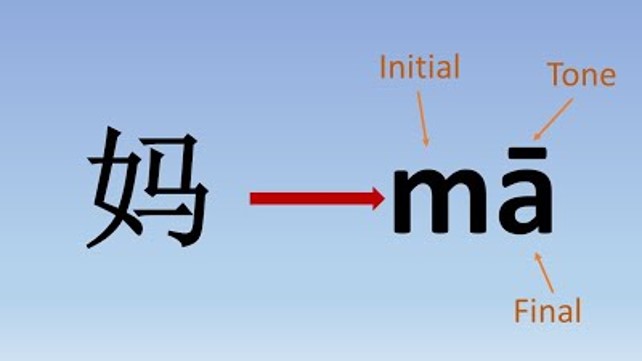
Example of Hanyu Pinyin System:
In every Hanyu Pinyin, there must be has initial, final and tone to make a complete word or syllables.
1. Initials ( Shengmu 声母 )
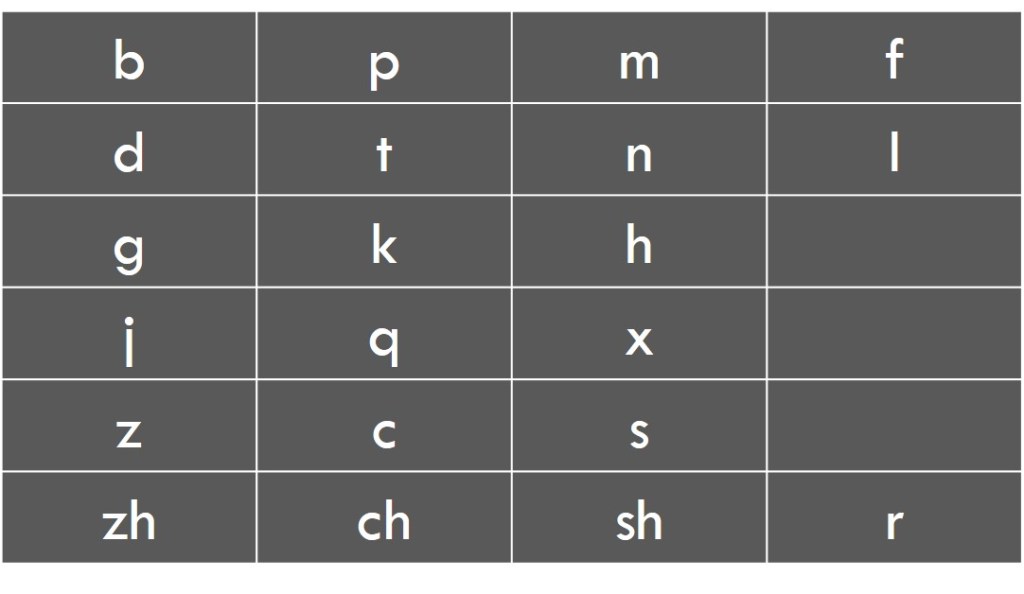
There are 21 initials recorded in Chinese phonetics. Initials are placed in front of the words. Initials are the consonant that begin the syllables.
Some of the initials can be read just same as English or Malay. But some other initials are quite difference to pronounce.
For example :
d and t b and p
d - say as the letter t
t - say same as the letter t but with the wind sound come out from mouth
b - say as the letter p
p - say same as the letter p but with the wind sound come out from mouth
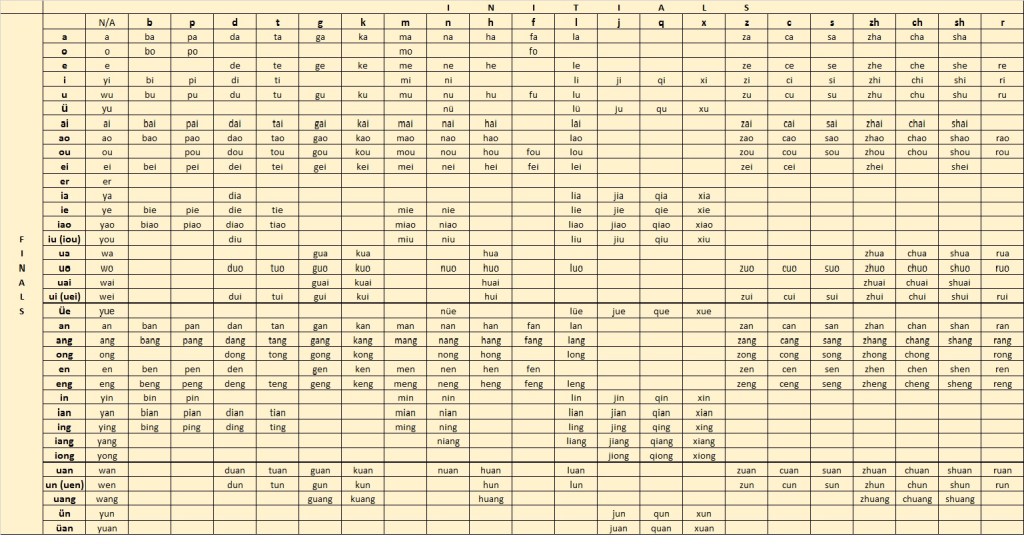
2. Finals ( Yunmu 韵母 )
There are 38 finals recorded in Chinese phonetics.
Finals are wrote after the initials, which are at the back. Finals normally started with vowels. Finals also can be mixed with consonants.
Finals are divided into 3 groups :
- Simple finals
- Compound finals
- Nasal finals
.

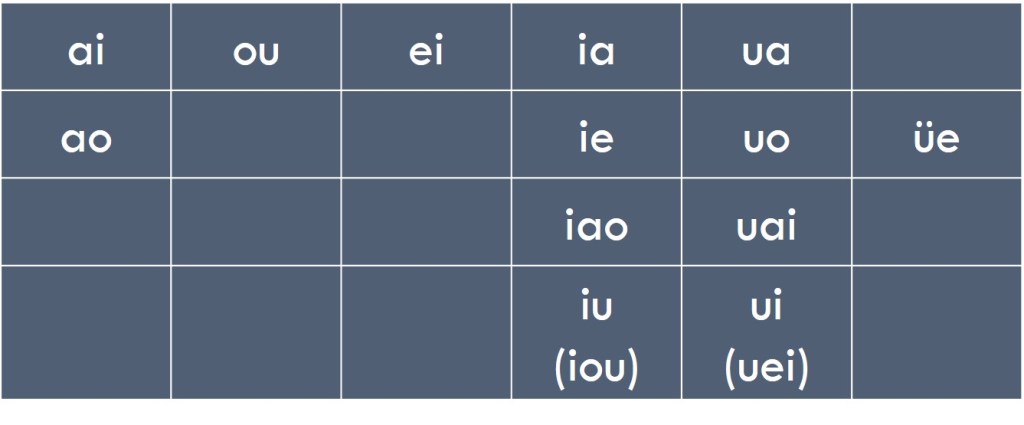
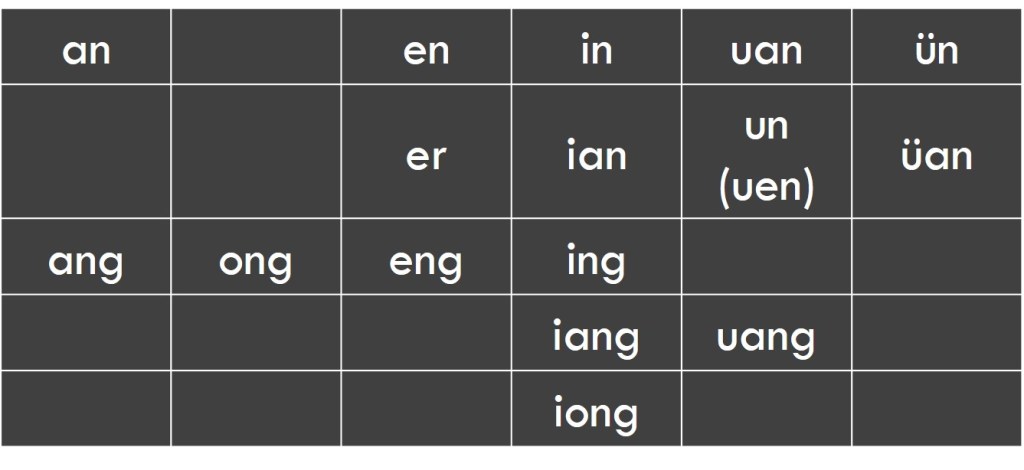
All the pinyin syllables in Mandarin can be concluded in the table below :
3. Tones ( Shengdiao 声调 )
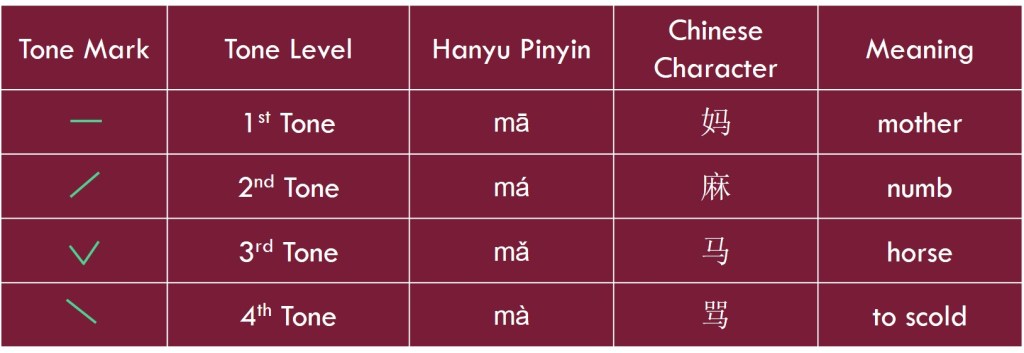
Mandarin is a tonal language which is when difference tones are pronounced, then the meaning will be difference.
In Mandarin, there are 5 tones that students need to know :
- 1st Tone (yi sheng)
- 2nd Tone (er sheng)
- 3rd Tone (san sheng)
- 4th Tone ( si sheng)
- No Tone ( qing sheng)
.
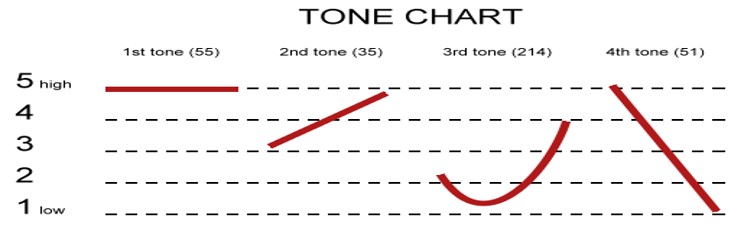
The 1st tone should be pronounced in highest pitch and flat. The 2nd tone starts from middle pitch and increase to the high pitch. The 3rd tone can be pronounced starts from lower pitch (no 2) to the lowest (no 1), then increase to the higher pitch (no 4). And the 4th tone will starts from highest pitch to the lowest pitch.
.
.
Tones Mark
There are 4 types of tone mark :
- Tone mark is always placed above the final.
- If the final contain more than one final, tone mark should be placed above the final in this order :
“a – o – e – i – u – ü ”

.
- The dot above the final “ i ” should be erased if the tone mark is placed above it.
Example : ī í ǐ ì
- If “ i ” and “ u ” are together, mark the tone on the last final.
Example : iù
- ( “ iu ” actually be said as “ iou ”, so according to the order a – o – e – i – u – ü, the letter of “ o ” is in front of the letter “ i ” and “ u ”. So the tone automatically be put on the letter “ u ” )
.
Tone Changes
In Mandarin, there are 3 situations where the tones change when we speak the words.
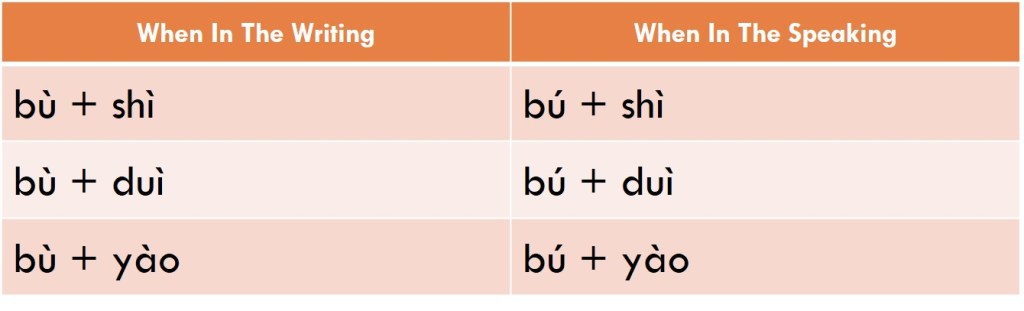
However, the tones are just changing when we say. Normally we do not change the tones in the writing.
The reason for this is that in many cases if the tone change is written, you will be confused as to what the “normal” tone of a character is actually supposed to be.
.
- Tone Changes for 不 (bù)
- When the word “ bù ” follows by the second word that has 4th tone, the tone of “ bù ” will be said as “ bú ”.
.
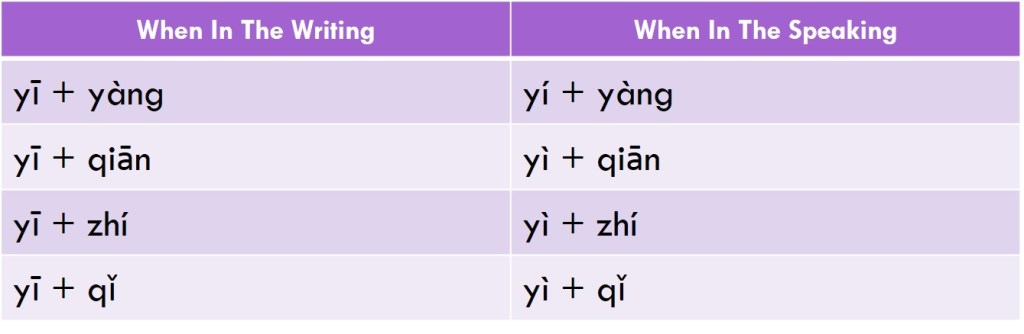
- Tone Changes for 一 (yī)
- When the word “ yī ” followed by a 4th tone, “ yī ” changes to 2nd “ yí ”.
- When the word “ yī ” followed by any other tone, “ yī ” changes to 4th “ yì ”.
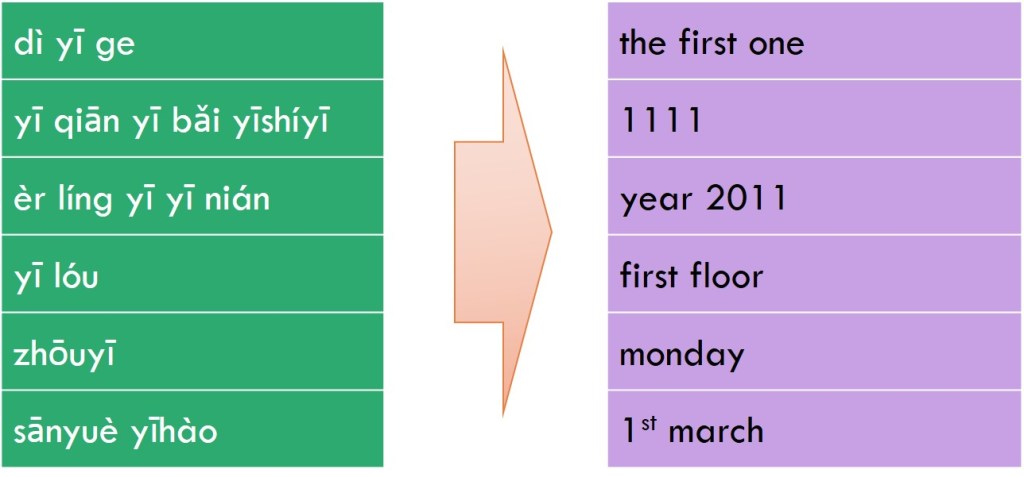
- When 一 (yī) appears as a number in a series, larger number, address, or date, it is pronounced without the tone change (regular first tone “yī”)
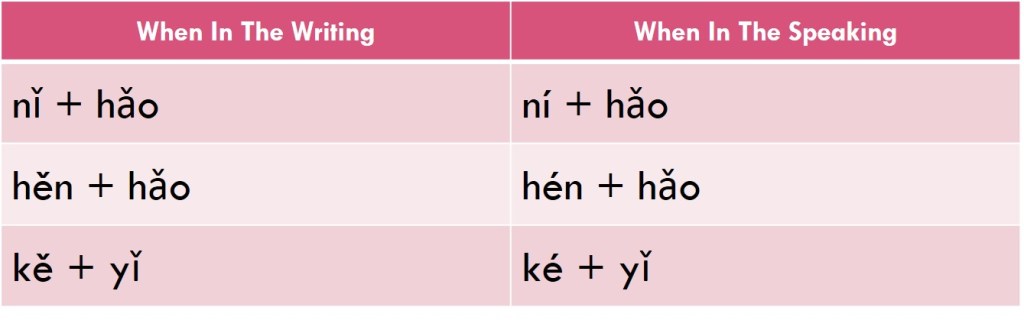
- Tone Changes for Multiple Third Tones
- When a 3rd tone is followed by another 3rd tone in a group, the first 3rd tone changes to a 2nd tone.
 Class of Mandarin